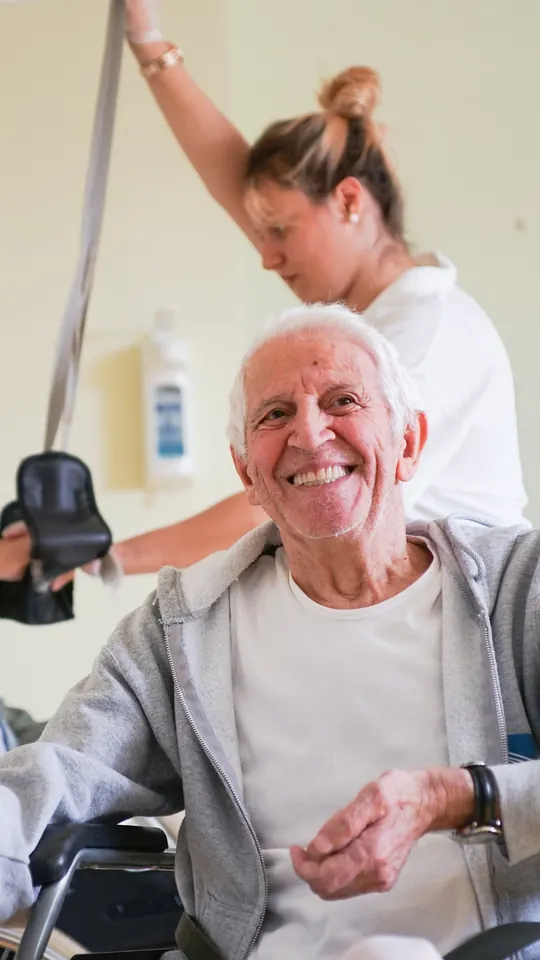
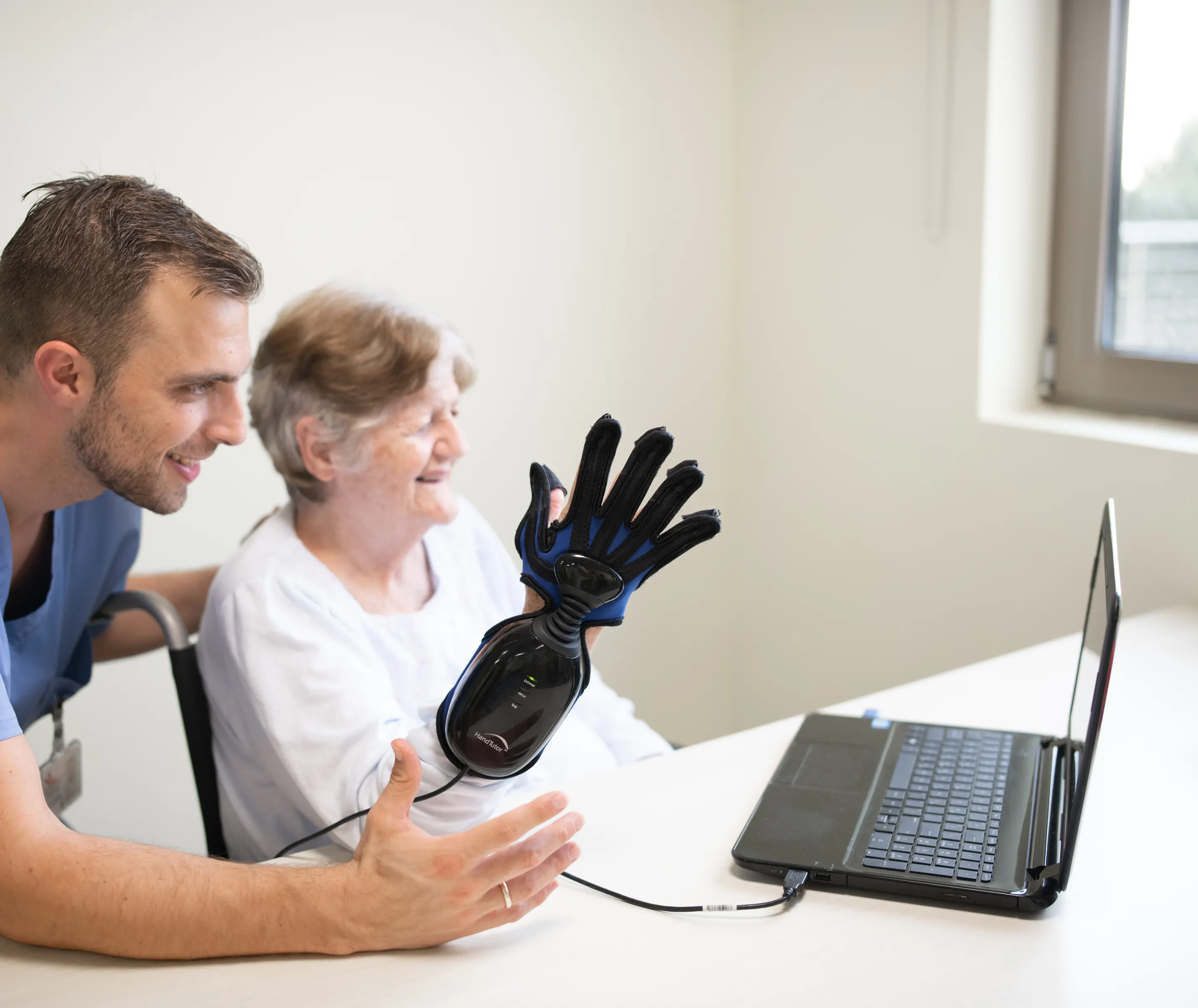
Occupational therapist and a laughing older woman practising hand movements with a robotic glove

Occupational therapy for daily living and arm and hand rehabilitation

Occupational therapy in a practice kitchen and bathroom, constraint-induced movement therapy, robotic arm and hand systems, seating and pressure mapping, and planning for your home in Ireland.

No referral or paperwork needed for the first call.

Occupational therapy at Evexia Plus

At Evexia Plus, occupational therapy is the part of your programme that works on everyday life: washing, dressing, cooking, using your arm and hand, and getting ready for home. Our occupational therapists work with people after a stroke, a brain or spinal cord injury or orthopaedic surgery, and with conditions such as multiple sclerosis and Parkinson's. A physician in Physical Medicine and Rehabilitation sets your goals with you, and your occupational therapist combines practice in real tasks with equipment such as robotic arm and hand systems. Occupational therapy is part of at least 3 hours of therapy a day, and the cost is reimbursable by the HSE.
The occupational therapy methods and equipment we use

Your occupational therapist chooses from these to suit your goals, and changes the plan as you progress.

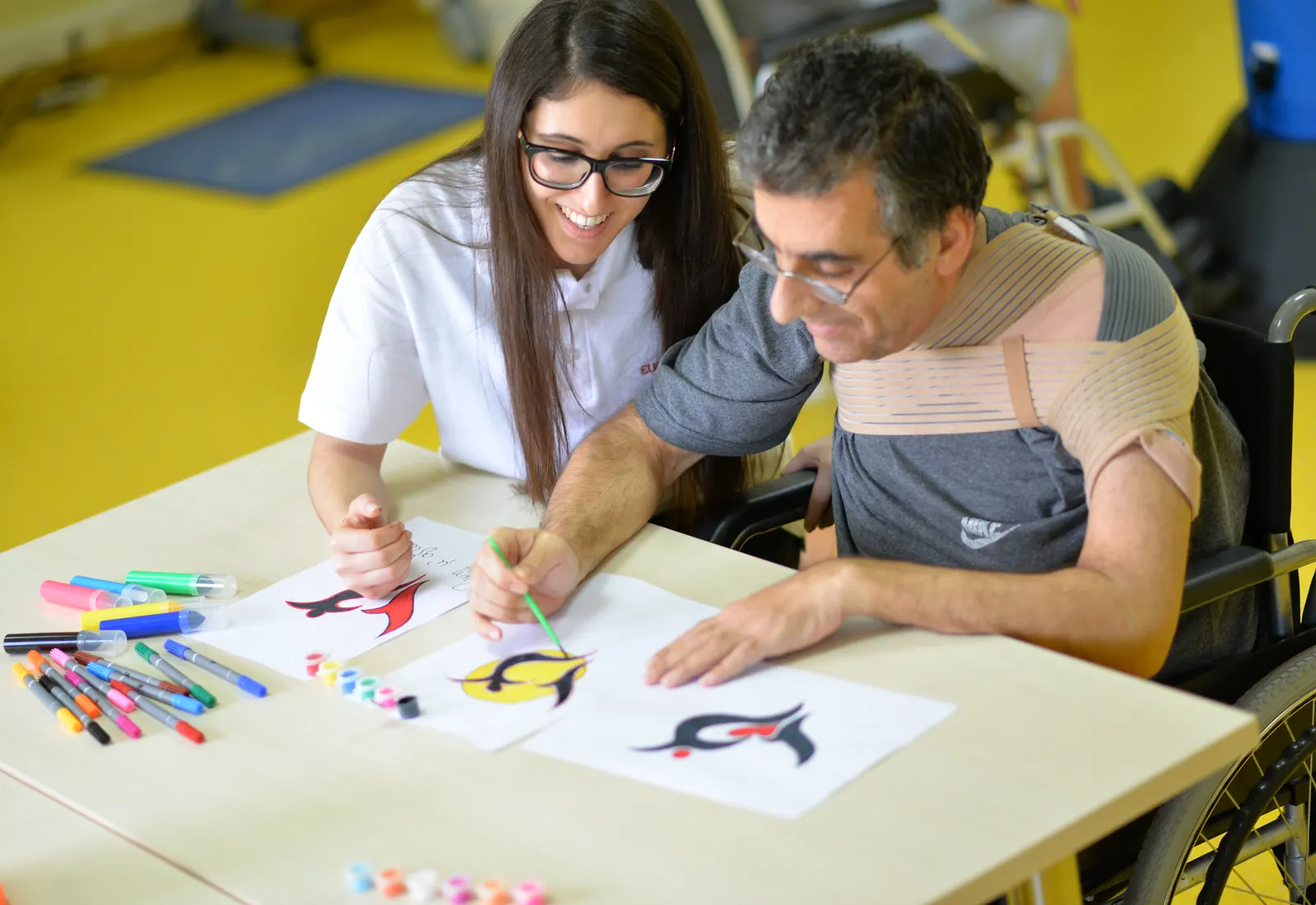
Occupational therapist beside a man in a wheelchair practising drawing with coloured markers

Arm and hand practice: constraint-induced movement therapy and two-handed training

Practice that gets your weaker arm and hand working in real tasks. In constraint-induced movement therapy, your stronger hand is gently restricted during set tasks so the weaker one does the work. Two-handed training practises tasks that need both hands.

Man in a wheelchair using a robotic arm system while his therapist points to the next target

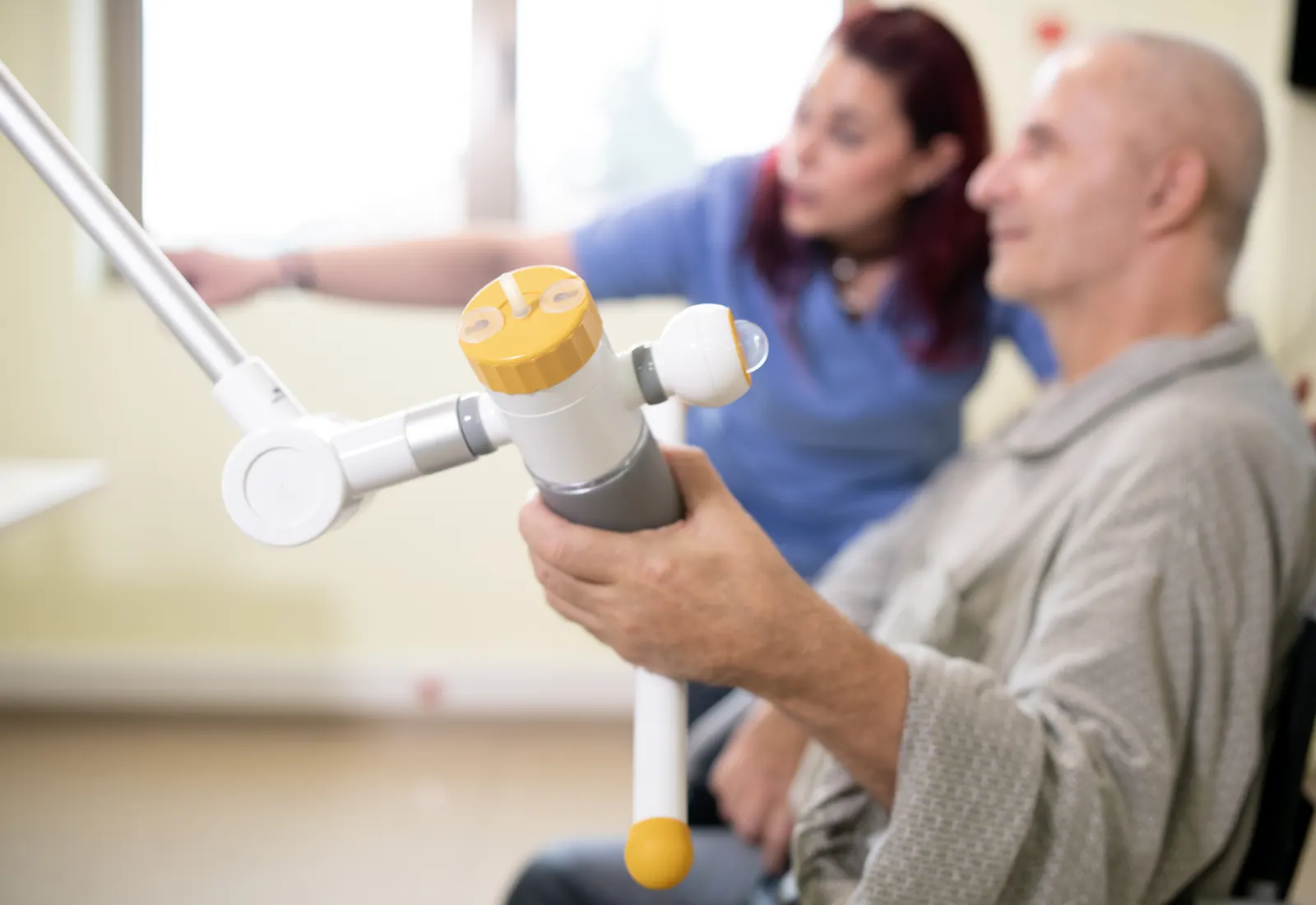
Robotic arm and hand systems and robotic gloves

Machines that support your arm or hand while you reach, turn and grip to play simple games on a screen, helping only as much as you need. A soft robotic glove opens and closes your fingers as you practise gripping and letting go. Both let you repeat a movement many times.

More methods and equipment

A practice kitchen and bathroom for daily living

Rooms set up like a kitchen and bathroom at home. You practise making a drink or a simple meal, washing and dressing, and getting on and off the toilet or into the shower, while your therapist checks safety and shows you easier ways.

Mirror therapy

A mirror is placed so that you see your stronger hand moving where your weaker hand would be, while you try to move both hands together.

Splints and air splints

Splints for a weak or stiff hand or wrist, made or fitted on site or ordered in, with checks of your skin. An air splint, a clear sleeve gently inflated around your arm, holds it straight during some exercises. For a stiff arm or hand, your therapist combines splints with stretching, task practice and robotic hand training.

Seating, pressure mapping and wheelchair skills

A check of your wheelchair, cushion and posture. A thin sensor mat on the seat shows a colour map of where pressure builds up, so the cushion and supports can be adjusted. You also practise handling your wheelchair safely.

Equipment for daily life

Trying out aids that make daily tasks easier, from adapted cutlery and dressing aids to simple technology, with training for you and your family. With your speech and language therapist, your occupational therapist also sets up communication aids so you can reach and use them.

Planning for home

Your family sends photos, measurements or a short video of your home, and your therapist plans equipment and changes, such as rails or a shower seat, while you practise the same tasks here. You leave with written recommendations.

Occupational therapy is part of the inpatient programme, which is reimbursable by the HSE under the EU Cross-Border Healthcare Directive.

You pay the hospital, then claim the cost back, and we give you every document the claim needs. It works the same way wherever you live in Ireland, whether that's Dublin, Cork, Wicklow, Cavan or Roscommon.

How it works, step by step

Questions about occupational therapy

Something else on your mind? Call us on 01 263 3051.

What does an occupational therapist do in a rehabilitation hospital?

An occupational therapist helps you get back to the everyday tasks that matter to you: washing, dressing, cooking, using your arm and hand, and managing at home. In hospital, that means practice in real tasks, equipment and seating that make daily life easier and safer, and a plan for going home. At Evexia Plus, occupational therapy is part of your daily programme.

Is occupational therapy the same as physiotherapy?

No, but the two work closely together. Physiotherapy focuses on movement: sitting, standing, balance and gait. Occupational therapy focuses on what you do with that movement in daily life, such as dressing, cooking or using your hand, and on equipment, seating and planning for home. Your rehabilitation physician agrees one set of goals for both.

What is upper limb rehabilitation?

Upper limb rehabilitation is therapy for a weak or stiff arm and hand, for example after a stroke. It includes practice in real tasks, constraint-induced movement therapy and two-handed training, mirror therapy, splints where needed, and robotic systems that help you repeat movements. The aim is to use your arm and hand in daily life, not only in exercises.

What is constraint-induced movement therapy?

Constraint-induced movement therapy (CIMT) encourages you to use your weaker arm by gently restricting the stronger one, often with a mitt, during set tasks. It suits people who already have some movement in the wrist and fingers. Your occupational therapist checks whether it suits you and combines it with two-handed training.

Will an occupational therapist visit my home?

Not in person, because your home is in Ireland. Instead, your family sends photos, measurements or a short video, and your occupational therapist plans equipment and changes from these while you practise the same tasks here. You leave with written recommendations to share with your team at home.

What is a seating assessment with pressure mapping?

It is a check of how you sit in your wheelchair. A thin sensor mat on the seat shows a colour map of where pressure builds up, so your therapist can compare cushions and adjust supports, and you can see why shifting your weight matters. It is especially useful if you sit in a wheelchair for long periods.

Is occupational therapy reimbursable by the HSE?

Yes. Occupational therapy is part of the inpatient rehabilitation programme, which is reimbursable by the HSE under the EU Cross-Border Healthcare Directive. You don't need a medical card or private insurance. We send a written estimate in English before you commit, and give you every document the claim needs.

Talk to us about occupational therapy

Tell us a little about you and what you'd like to work on. We reply within one working day, Monday to Friday.
Thank you. Your enquiry has been received. We will reply within one working day, Monday to Friday. If you need to speak with us sooner, please call 01 263 3051.
Your enquiry could not be submitted. Please try again, or contact us directly on 01 263 3051 or at info@evexia.ie.